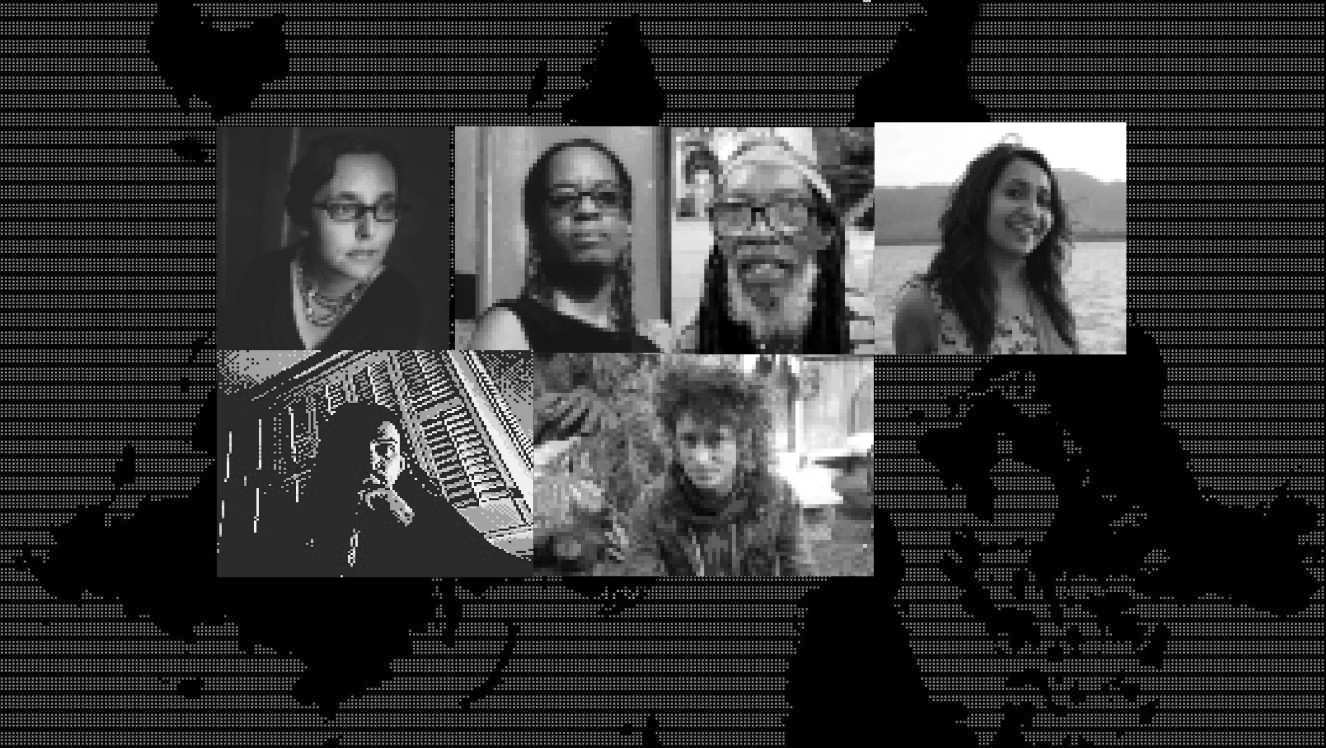
We are a research network of artists, activists, educators, and technologists studying and designing political software of various kinds!
Meet the members of our project:
-
Authors:
-
Sucheta Ghoshal is an assistant professor at the Department of Human Centered Design & Engineering at the University of Washington (UW) where she directs the research group Inquilab. She is interested in studying – and building – computational cultures that refuse, resist, subvert, or exceed the state and market imaginaries of computing. As a community organizer and researcher, she has worked across South Asia, the U.S. South, and now the U.S. Pacific Northwest, studying how computational technologies are used and appropriated to liberatory ends, tracing possibilities in computation for such subversion and appropriation, while co-designing tools of resistance in solidarity. Her current projects examine the formation of – and refusal/resistance to – computational regimes shaping the realms of migration, agriculture, and labor. Her work simultaneously investigates the physical and political architectures of computation itself, from data centers to the broader tech industry that underwrites them.
-
Carmin Karasic is a multimedia artist and learning architect whose work bridges digital activism, technology, and adult learning. A founding member of the Electronic Disturbance Theater, creators of FloodNet and pioneers of electronic civil disobedience, she explores how art and code can challenge systems of power while fostering critical digital literacy. She holds a BS in Mathematics and Computer Science, and an MFA in Visual Arts. She has exhibited internationally and currently serves as a Senior Learning Architect at ASML. Karasic has led and advised arts organizations, including Boston Cyberarts (USA), Baltan Laboratories (NL), and MAD Emergent Art Center (NL).
-
Jeff Ward founded Animikii in 2003 and has orchestrated its growth ever since. Everything Jeff does is geared toward uplifting his family, communities and Indigenous Peoples. He is Ojibwe and Métis, originally from Manitoba, and now lives and works in Victoria, BC on Lekwungen territory. Jeff is a software developer, product designer, author, and speaker. He has served on the board of Aboriginal Peoples Television Network (APTN) and its subsidiaries since 2018 and is a founding board member of the Indigenous tech circle. He also serves on the OECD Global Partnership on AI (GPAI) Experts Working Group on Responsible AI and is a Fellowship Leadership Judge for MIT Solve.
-
Swati Janu is an architect, activist and artist who works on issues of social justice from housing rights to participatory planning. Her inter-disciplinary practice combines community engagement with policy advocacy across Indian cities. For her critical spatial practice, Swati was recently awarded the Moira Gemmill prize in Emerging Architecture 2022 which is aimed at creating gender inclusion in architecture and urban design.
-
TC Silva is musician, composer, arranger, musical instrument maker, and founder of Casa de Cultura Tainã (Campinas, São Paulo, Brazil). He was also musical director of the Steel Drum Orchestra and active organizer of the Unified Black Movement since 1972. Recipient of the Order of Cultural Merit from the Presidency of the Republic (2006) for his contributions to digital culture in Brazil. He is the son of Geralda Santos Silva and Alfredo Januário.
-
paul scheizer is a geographer, activist and popular educator. He is a lecturer at the Institute of Experimental Design and Media Cultures, Basel Academy of Arts and Design, Switzerland, and is currently conducting his PhD at Martin-Luther-University Halle-Wittenberg, Germany, and the Federal University of Rio Grande do Sul, Brazil, investigating methods and means of design of collective mapping. As part of kollektiv orangotango, since 2009, paul has been conducting activist research and collaborated with social movements in urban contexts in Germany, Italy, Brazil, a.o. He co-edited the books This Is Not an Atlas – A Global Collection of Counter-Cartographies (2018) and Beyond Molotovs – A Visual Handbook of Anti-Authoritarian Strategies (2024).
-
Micah Anderson is the Senior Director of Engineering at The Tor Project, where he leads six globally distributed engineering teams responsible for keeping Tor’s privacy and censorship-resistance tools reliable, secure, and accessible to millions of people around the world. He has been a technology strategist, free software developer, and author, consistently focused on building distributed, participatory systems that expand human rights and digital freedom.
-
Biella Coleman is the Ernest E. Monrad Professor of the Social Sciences in Harvard’s Department of Anthropology, a faculty associate at the Berkman Center for Internet and Society. An anthropologist of science, technology, and medicine, her work examines the politics, cultures, and ethics of hacking. She is the author of Coding Freedom (Princeton, 2013) and Hacker, Hoaxer, Whistleblower, Spy (Verso, 2014), the founder and editor of Hack_Curio, and the host of the 2022 BBC4 podcast series “The Hackers.”
-
Ricardo Dominguez is the chair of the Department of Visual Arts, UCSD. He was a founding member of Critical Art Ensemble and a cofounder of Electronic Disturbance Theater 1.0 (EDT), a group who developed virtual sit-in technologies in solidarity with the Zapatista communities in Chiapas, Mexico, in 1998. With Electronic Disturbance Theater 2.0/b.a.n.g. lab project with Brett Stalbaum, Micha Cardenas, Amy Sara Carroll, and Elle Mehrmand, the Transborder Immigrant Tool (a GPS cell phone safety net tool for crossing the Mexico/US border) was the winner of “Transnational Communities Award” (2008), an award funded by Cultural Contact, Endowment for Culture Mexico–US and handed out by the US Embassy in Mexico.
-
Heitor Guimarães is a researcher-activist from Belém do Pará, Brazil. He is a member of Rede Mocambos and Cultural Center Casa Taina where he collaborates on community-based research and international communications. He is pursuing a master’s degree in Political Philosophy at the State University of Campinas, Brazil and currently working as a Visiting Researcher at the W.E.B. Du Bois Department of African American Studies at the University of Massachusetts Amherst.
-
-
Editors:
-
Luis Felipe R. Murillo is Assistant Professor of Anthropology at University of Notre Dame. His work is dedicated to the anthropological study of the “common(s)” in science and technology with a focus on political cultures of computing. Before starting at Notre Dame, he worked as post-doc at Conservatoire des Arts et Metiers in Paris, France, studying the incorporation of community projects into public research organizations, such as the European Organization for Nuclear Research (CERN). He has been studying and working with common technologies since the early 2000s. He is the author of “Common Circuits: Hacking Alternative Technological Futures” (Stanford University Press, 2025).
-
Erin McElroy is an Associate Professor in the Department of Geography at the University of Washington, where their work focuses upon intersections of gentrification, technology, empire, fascism, and racial capitalism, alongside housing justice organizing and transnational solidarities. McElroy is author of “Silicon Valley Imperialism: Techno Fantasies and Frictions in Postsocialist Times” (Duke University Press, 2024) and coeditor of “Counterpoints: A San Francisco Bay Area Atlas of Displacement and Resistance” (PM Press, 2021). They are also cofounder of the Anti-Eviction Mapping Project and Landlord Tech Watch.
-